
When Broad Run Recycling recently became the first C & D recycling facility certified by the Recycling Certification Institute (RCI), owner Kevin Herb saw the certification as both an honor and an indication of the challenges facing the industry. Although he is pleased to see Broad Run Recycling recognized for its diligent recycling practices, he hopes the novelty of the certification is short-lived, wanting more facilities to become certified within the near future in order to help the industry adapt and grow. To Kevin Herb, the benchmark needs to become the norm if the C & D recycling industry is going to capitalize on the increasing demand for green construction practices, alternative energy, and transparent business practices.
Industrial C & D Recycling
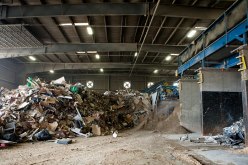
Broad Run Recycling operates a 26,000 square foot MRF (Materials Recycling Facility) in the Washington, D.C. metro area. Specializing in industrial construction and demolition debris (rather than residential C & D), Broad Run has the capacity to process more than 1,500 tons per day of wood waste, aggregate, cardboard, drywall, metals, and dirt.
The RCI certification acknowledges Broad Run’s high recycling rates—close to 100% of the typical roll-off dumpster coming from a construction site. By comparison, only 50% is needed to qualify for one LEED point, 75% for two LEED points, and 95% for three LEED points. Achieving high recycling rates is not simple or easy, Herb notes. A newcomer to the C & D industry just five years ago, Herb extensively researched equipment and best practices prior to installing a sorting and recycling system capable of handling the full range of industrial C & D.
“The grinder looked good on paper, but the real numbers prove this machine to be a great investment.”
Wood Recycling Simplified
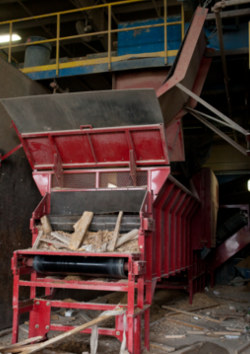 One critical step in attaining Broad Run’s current recycling rates was the relatively recent addition of a wood grinder. Broad Run added a Rotochopper EC-256 electric horizontal grinder in early 2013. Prior to installation of the Rotochopper EC-256, Broad Run had been stockpiling wood waste and selling it at a low margin to a local landscape mulch producer.
“The wood recycling portion just didn’t come together for us until I discovered Rotochopper a few years after building the rest of the system,” Herb states. “We tried a couple different approaches, but none of them had the same streamlined efficiency as the rest of our process.” The first unsuccessful approach was a slow-speed shredder. Kevin notes that, while the slow-speed shredder was well designed and built, it was not the right machine for sorted C & D. Herb and his business partners initially assumed the shredder would be more versatile than a high-speed grinder, capable of processing wood waste, as well as shredding the miscellaneous garbage they were unable to recycle on-site, reducing its volume to lower the hauling costs. “Slow speed shredders are really impressive machines in the right applications, but our materials fell outside of a shredder’s target applications. We couldn’t make a decent product from the wood, and it didn’t shred the trash well either.”
After unsuccessfully trying for a few months to dial in the shredder to fit their applications, Herb sold the shredder and began selling unprocessed wood waste to other companies that operated grinders. Besides lowering the value of the wood fiber, selling the wood waste without processing created several challenges. “We were at the mercy of someone else’s schedule. Since we can’t control the flow of raw materials coming into our facility, we need to control the flow of material going out. We had a big mess when we had to wait for someone to take our wood waste.”
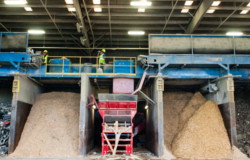
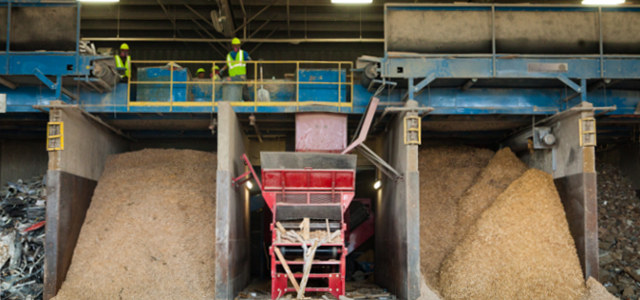
The EC-256 has simplified the wood grinding process well beyond Herb’s expectations. “When you see the EC-256 running in our facility, it seems like it was designed from scratch to fit our set-up,” he says. Before integrating the EC-256, Broad Run had been using three bunkers below the picking line to stockpile wood. Now the EC-256 occupies one bunker and fills the adjacent bunker with properly ground wood fiber using a bunker filling system custom made for Broad Run.
“My Rotochopper rep mentioned that the grinder could be easily integrated with various handling systems for feeding the raw waste and moving the end product. But we didn’t have the material handling capabilities we wanted for the finished product and didn’t want to mess with another supplier. So Rotochopper built it for us.”
Customized to Match Broad Run’s Facility
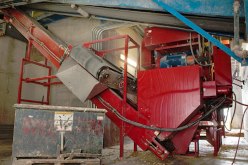 When he first began discussing a grinder with his Rotochopper representative, Jody Parker, Herb stressed that the addition of a grinder could not increase the footprint of the current sorting system. Herb worked with Jody Parker and Rotochopper engineers to customize the EC-256 and its end product handling system. The EC-256 sits within a bunker below the picking line with enough room to remove screens and perform routine maintenance. The custom built handling system fills the entire adjacent bunker with finished wood fiber automatically.
“The unique solution Rotochopper provided for us really gives us a hands-off, no fuss process for taking raw waste to engineered fiber. After we pick the other materials from the wood, we don’t need to handle it until we load it in a trailer.”
As Herb relates, the minimized handling was just one of the benefits of the EC-256 that surpassed Herb’s expectation. Even though the EC-256 is the second smallest Rotochopper electric grinder, it has always matched the volume coming from Broad Run’s picking line. “My Rotochopper rep put some numbers in a spreadsheet to forecast my operating and maintenance costs for my EC-256 grinder. When I got my first power bill, I was really surprised to see that those projections were actually pretty conservative. The grinder looked good on paper, but the real numbers prove this machine to be a great investment.”
The Product Sells the Service
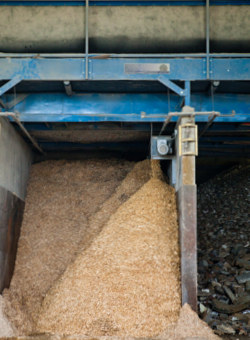 Besides turning wood waste into saleable fiber, the EC-256 has been instrumental in marketing the services Broad Run provides. Herb notes that the EC-256 has transformed a messy process into a streamlined outbound flow of fiber commodities. The EC-256 has helped Broad Run create a cleaner, safer, more professional environment. “When we give tours of our facility, the Rotochopper grinder tells the whole story. Our customers see the raw wood waste, the grinder, and the finished product all in one clear process. They see a beautiful fiber product right next to the grinder. It’s a great example that shows what we are all about: turning waste into products.”
By maintaining strict wood fiber specifications, Broad Run always has a steady demand for recycled wood fiber products. “The fiber consistently looks great, and my buyers know that,” Herb says. Most of the fiber goes into biomass applications, some to landscape wholesalers. All of it easily finds an end use thanks to careful sorting and uniform particle size.
As Herb notes, a steady outgoing flow of material is critical for C & D recyclers. “We put a lot of effort into developing a sorting system that runs day after day without downtime or hassle. We needed the same from our grinder, and we got it. The wood grinding and fiber handling system worked from day one, and it has ever since. The whole process—delivery, installation, start-up, and training—went like clockwork. We’ve had no surprises.”
Meeting Market Demand
With the wood grinder completing the sorting and recycling system, Broad Run is looking to expand into another facility that duplicates the efficiency of the existing system. Ultimately, Herb sees the success of Broad Run and the recent RCI certification as a simple matter of meeting market demand. “Recycling is not only the right thing to do; it’s the smart thing to do. The customers we serve want higher recycling rates. The days of landfills are coming to an end. Putting waste into a landfill is profitable, but converting the material into alternative fuel and other products has greater profit potential. It will be a slow process, but the trend is clear. The demand is only going to grow.”